Temporal Flux

From The Axis Vault Gallery-Auburn, NY

Exhibition Note: Temporal Flux

By Julian Vought, Senior Critic, The Modern Perspective

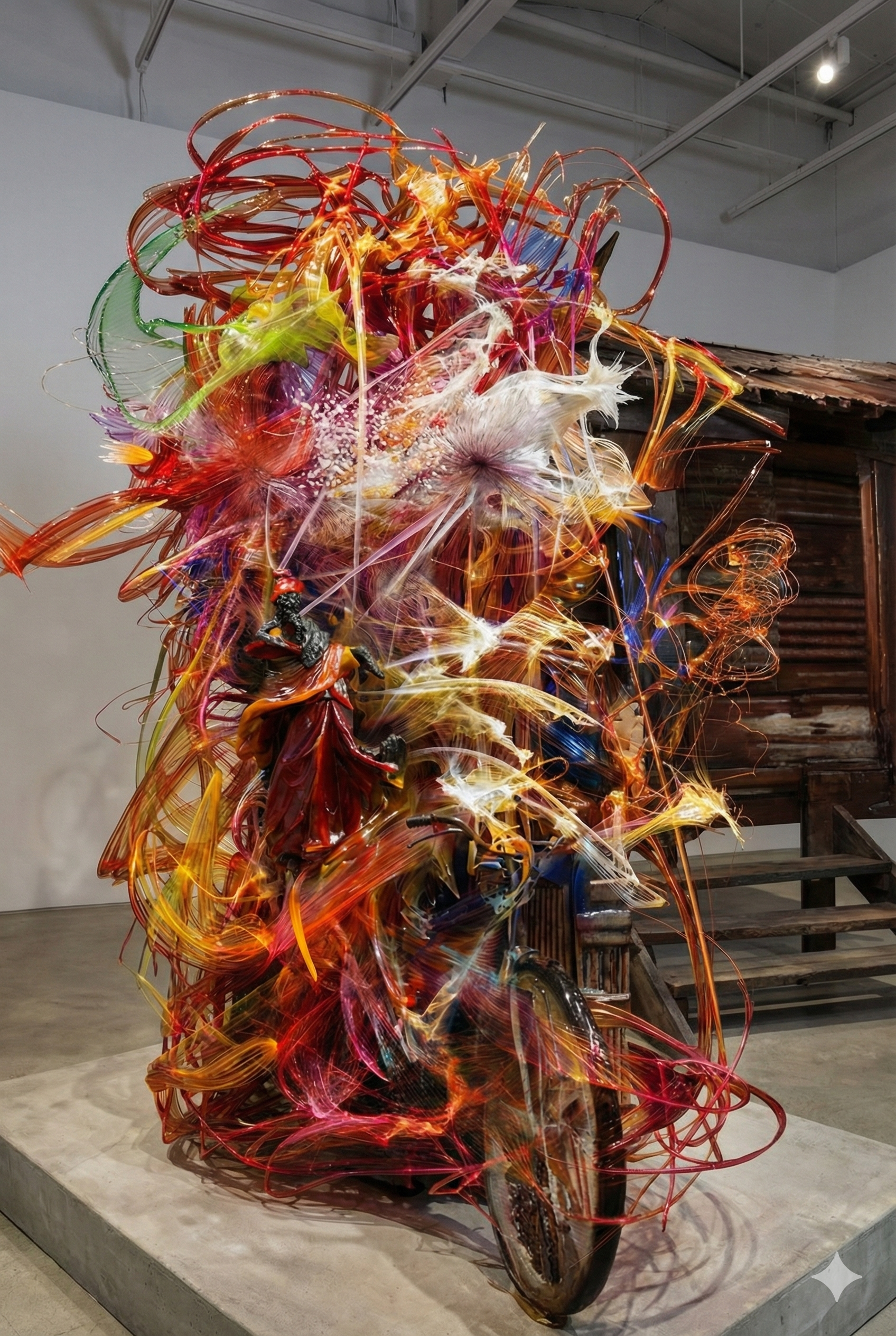
To step into the presence of Temporal Flux is to witness the violent, beautiful unraveling of a memory in real-time. The installation does not merely occupy space; it actively contests it, staging a kinetic war between the analog weight of history and the searing, immaterial velocity of the digital age.

At first glance, the eye fights for purchase. We are grounded by the familiar: the rough-hewn, charred timber of a vernacular shack, the rust on a vintage bicycle’s fender, the weary posture of a commuter frozen in transit. These are the artifacts of a slow world—tactile, heavy, and silent.

But this stillness is deceptive. It is being cannibalized.

The artist has interrupted this pastoral tableau with a ferocious injection of chaotic luminosity. This is not the warm glow of a hearth; it is the cold, frantic energy of a corrupted file. Thousands of filaments of electroluminescent wire and twisted, sandblasted acrylic do not just “surround” the subject—they obliterate it. The figure on the bicycle is not riding; they are dissolving. They are being translated, byte by agonizing byte, into pure frequency.

There is a profound melancholy in this disintegration. The rear wheel of the bicycle, reconstructed from bent light and void, suggests that forward motion is no longer possible in a physical sense—only a scattering into the ether.

We are looking at a “glitch” manifest in three dimensions. The sculpture asks the uncomfortable question of our era: As we upload our lives into the cloud, what happens to the heavy, physical vessels we leave behind?

The brilliance of Temporal Flux lies in its refusal to let us look away from the collision. The light is too bright, the wood too dark. It captures the precise millisecond where the solid world surrenders to the speed of light—a permanent, suspended explosion that feels less like a sculpture and more like a warning.

JBLArtist.com, Humainty's Heartbeat

The Curator of Distorted Dreams”

From The Axis Vault Gallery

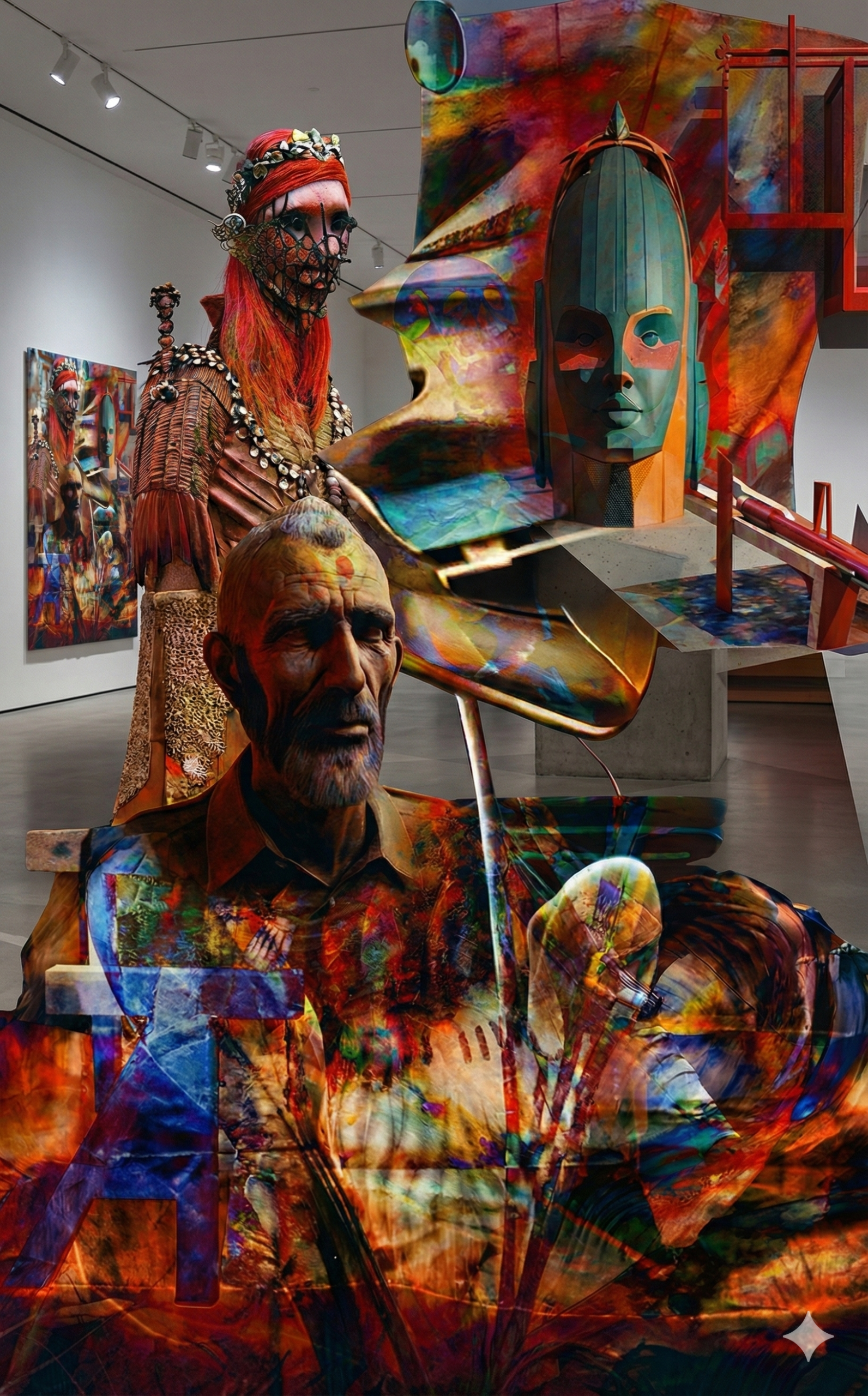
This piece presents a compelling, if disorienting, meditation on the dissonance of the contemporary human experience. The composition utilizes a stark juxtaposition between the hyper-realistic, weary visage of the central male figure and the surreal, fragmented avatars that loom behind him—one tribal and organic, the other geometric and futuristic. This visual tension suggests a psychological stratification, where the subject is not merely an observer but a vessel for conflicting eras and identities. The overlay of vibrant, glitch-like abstract textures across the lower foreground disrupts the spatial depth, forcing the viewer to question the stability of the narrative reality. While the chaotic color palette risks overwhelming the somber expression of the central figure, it ultimately succeeds in conveying a sense of sensory saturation, effectively mirroring the modern condition of being perpetually caught between an ancestral past and a digital, uncertain future.

jblartist.com

From The Axis Vault Gallery-Auburn, NY

This is a gallery narrative written in the voice and style of Julien Levy (1906–1981), the pioneering American art dealer who introduced Surrealism to the United States. His gallery was a haven for the experimental, the dreamlike, and the uncanny.

EXHIBITION: The Sleepwalker’s Relic

MEDIUM: Psychosexual magma, arrested in time.

A Note from Julien Levy:

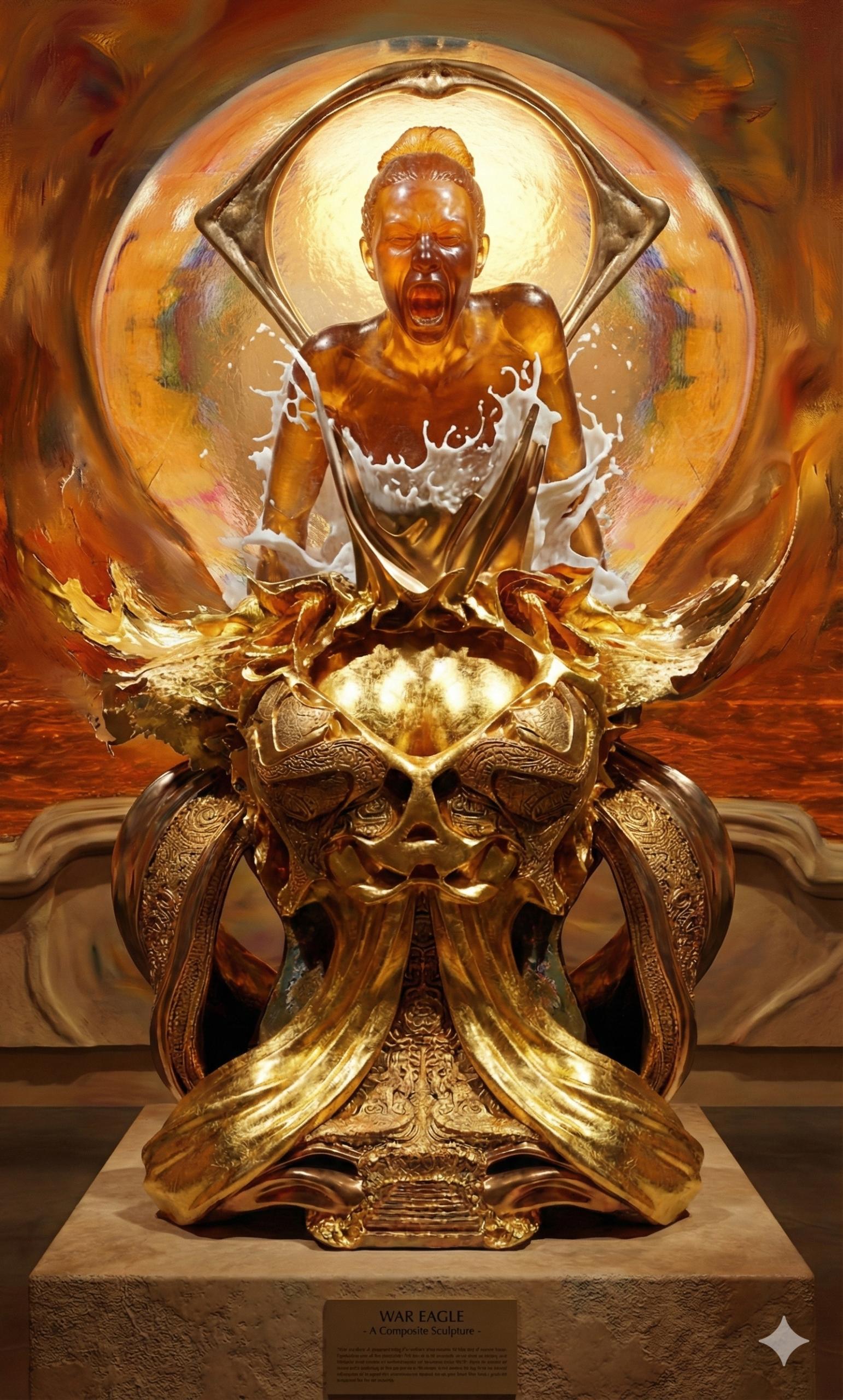
We do not invite you to look at sculpture today. Looking is too passive an act for what sits before you on this wooden altar. We invite you, instead, to witness an eruption.

This object is a fugitive. I have it on good authority that it began its life trapped in the two-dimensional prison of a canvas, a flattened hallucination. Yet, through some spasm of the artist’s will—or perhaps a failure of reality itself—it refused to stay put. It has burst forth, shedding its skin of paint and reassembling itself into this terrible, undeniable solidity.

It is a marvelous monstrosity.

Look at the color. It is not the orange of a fruit or a sunset. It is the color of amber that has trapped a prehistoric scream. It is the color of dried blood on a bandages, illuminated from within by an alchemical fire. It is the hue of a fever dream just before waking.

And the texture—ah, the “convulsive beauty” that Breton speaks of! It has not been sculpted by chisel or hand. It appears, rather, to have been vomited by the subconscious and instantly calcified upon contact with our cold air. It is a landscape of ruined desires, a topography of scar tissue. It is sticky to the eye, yet repulsive to the touch.

As you circle this L’objet Incendié, consider its form. Is it a figure? Two lovers fused in a Pompeian catastrophe? A piece of furniture possessed by a demon? It is all of these and none. It is the precise moment when the recognizable world melts into the irrational. It is a monument to that fleeting split-second between a nightmare and the waking world, frozen forever in amber slag.

Approach with caution. It is a beautiful, fragile brutality. It does not belong in this clean light. It belongs in the attic of your mind, the thing you find when you are looking for something else entirely.

— Julien Levy, New York City

From The Axis Vault Gallery-Auburn, NY

Exhibit Title: Visceral Convergence: The Corporeal Echo

Curator: Dr. Elena Vance, Senior Curator of Contemporary Sculpture

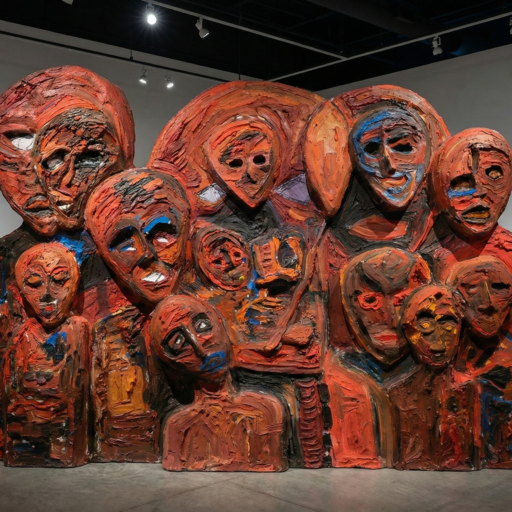
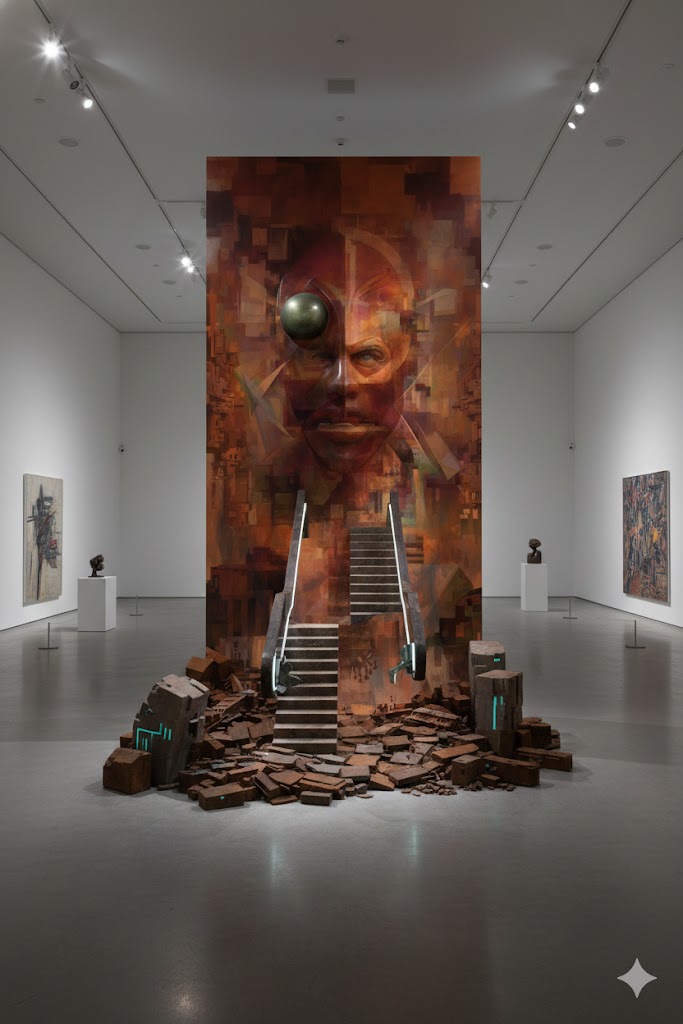
In Visceral Convergence, the artist transmutes the frantic energy of expressionist painting into a formidable, life-sized monolith, effectively dissolving the barrier between the viewer and the artwork’s subjects. The sculpture’s surface—a tactile landscape of gouged ridges and heavy, sanguine impasto—suggests figures dredged from the earth rather than carved, embodying a raw, biological heat that pulses through the collective mass. Here, the individual is subsumed by the communal; distorted, mask-like faces huddle in a hierarchy of scale that evokes generational weight and stoic endurance. By thrusting these archetypes into the three-dimensional realm, the artist orchestrates a profound confrontation, transforming the gallery from a space of observation into one of silent, reciprocal witnessing where the viewer is compelled to stand amongst, rather than apart from, this haunting crowd.

Survive The Future

From The Axis Vault Gallery-Auburn, NY

Title: The Destruction of the Silhouette

Statement by the Artist Pablo Picasso

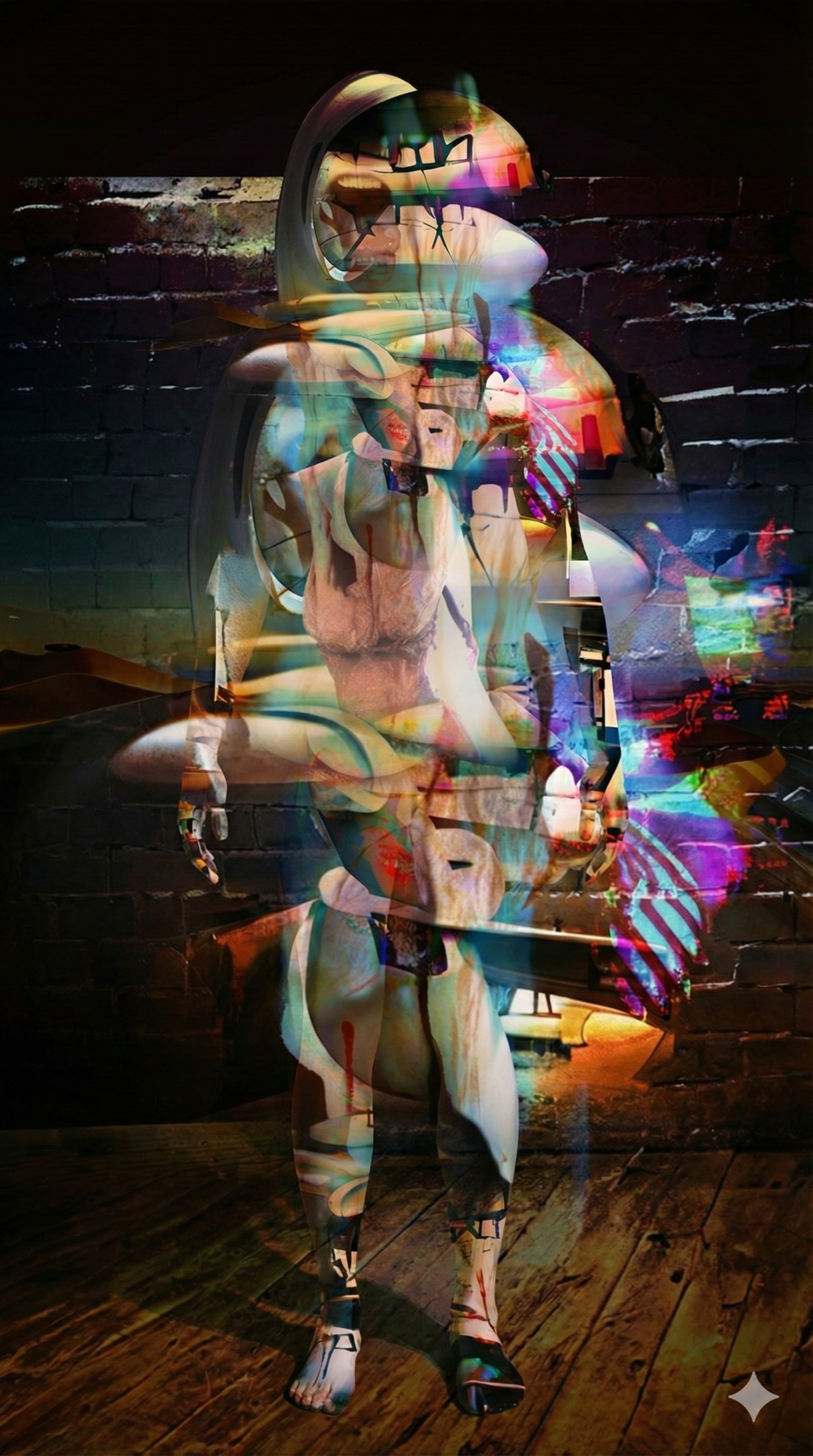
You look at this and you ask, “Where is the skin? Where is the solidity?” You are looking with the lazy eye of the camera. You must look with the eye of the mind.

I have said before that to draw, you must close your eyes and sing. To make a sculpture, you must break the bones.

I. The Lie of the Surface

For centuries, we have been obsessed with the shell. We polish the marble until it looks like soft flesh, but this is a deception. This work? This is the truth. It is Analytical Cubism reborn in light. I painted the woman weeping, I painted her face from the front and the side simultaneously to show you the totality of her existence. This form does the same. It is transparent not because it is empty, but because it is full—full of the wall behind it, full of the air, full of the noise of your machine world.

II. A Portrait of Velocity

Look at the mouth. It is open. Is she eating? Is she screaming? Is she breathing? She is doing all of these things at once. The colors that cut across her face—these “glitches”—they are not errors. They are the violence of time. In my paintings, I used sharp angles to show the aggression of the modern world. Here, the light itself is the blade. It slices the torso; it dissects the anatomy without a scalpel.

III. The Architecture of the Soul

Notice the brick wall. It is the only thing that stands still. The human is a ghost, a vibration. We are not solid. We are a collection of memories, pains, and moments held together by a fragile tension. This sculpture admits what we are afraid to say: that we are always falling apart, and we are always putting ourselves back together.

It is ugly? Perhaps. But it is alive. And art is not made to decorate apartments. It is an instrument of war against the brutality of the blank canvas. This figure stands in the fire of its own disintegration, and yet, it stands.

The Weight of Modern Existence

From The Axis Vault

State of Matter: The Weight of Modern Existence

This installation confronts the specific anxieties and paradoxes of modern existence—a life lived simultaneously in the physical realm of touch and gravity, and the simulated, weightless sphere of digital experience. By transforming abstract energy into tangible, monumental mass, the artist challenges the contemporary devaluation of the real, the raw, and the persistent.

The Digital Disembodiment

In an era defined by digital abstraction, where selfhood is increasingly mediated through screens and filtered images, J’s sculptures demand a return to corporeality.

The forms, characterized by their immense physical weight and rough, pockmarked surfaces, resist the smooth, perfected aesthetic of the digital age. They are reminders that the body is inherently messy, subject to decay, and marked by time—a direct counterpoint to the ephemeral, endlessly editable self presented online.

The raw, visceral reds and earthy browns emphasize our biological roots, serving as an antidote to the perceived weightlessness of modern life, where labor and connection often occur without tangible physical output.

The Fracture of Modern Identity

The sculptures’ fragmented, clashing compositions—especially the juxtaposition of the rough, chaotic ceramic mass with the stark, cold purity of the marble-like segments—reflect the fractured modern identity.

The monumental forms embody the tension between our primal, subconscious self (the volcanic, molten clay) and the hyper-rational, organized persona required for navigating complex technological societies (the angular, white elements).

The installation suggests that the modern self is not whole, but a constant, uneasy negotiation between these elemental forces, resulting in an existence that feels simultaneously heavy with anxiety and lacking in solid ground.

Enduring the Information Flood

Ultimately, State of Matter serves as a sanctuary of endurance against the relentless flow of modern information and obsolescence. While technology seeks to constantly replace and update, these sculptures are built to survive. Their ceramic and stone nature signifies deep time.

They ask: What endures when everything is fluid? The answer, J suggests, is the stubborn, undeniable fact of matter—the enduring physical reality of the earth and the body, which persists long after the last digital feed goes dark.

Cultural Resonance

From The Axis Vault Gallery, Auburn NY

Cultural Resonance

This installation critiques the spectacle of modern life:

• Alienation through technology

• Fragmentation of identity

• Emotional suppression in favor of performance

Yet it also offers a mythic lens: each figure is an archetype in the ceremony of becoming. They are not just victims of civilization—they are its mirrors, its challengers, its potential redeemers.

JBLArtist.com

Thresholds of Humanity

From The Axis Vault Gallery-Auburn, NY USA

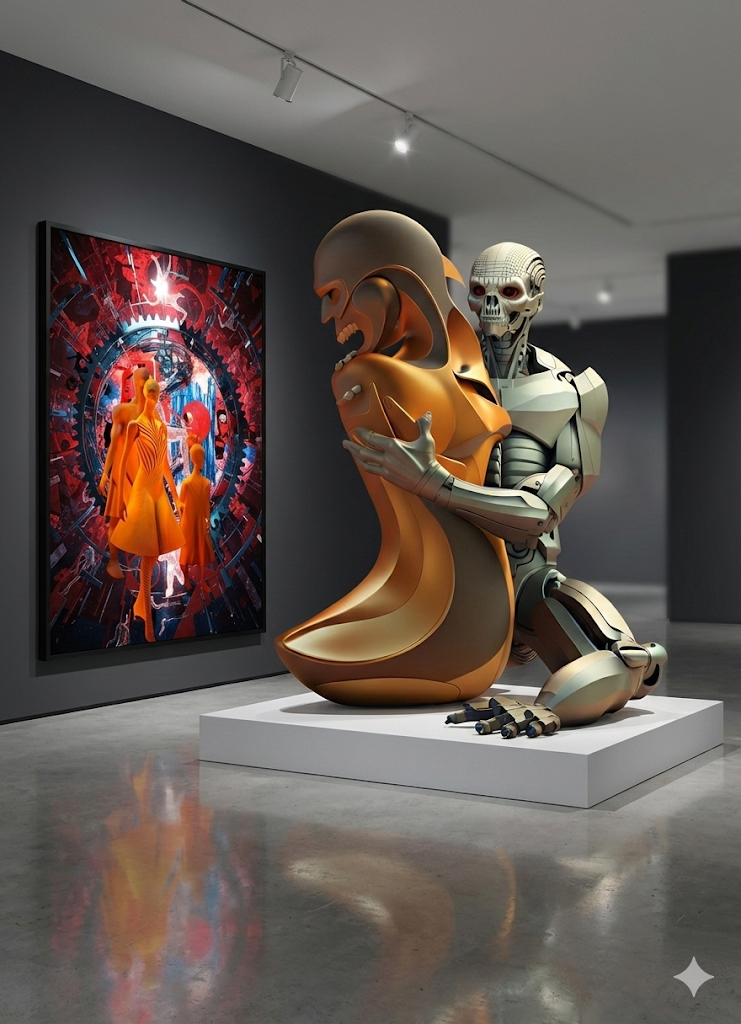
Exhibition Title: The Synthetic Embrace: Thresholds of Humanity

Curatorial Statement

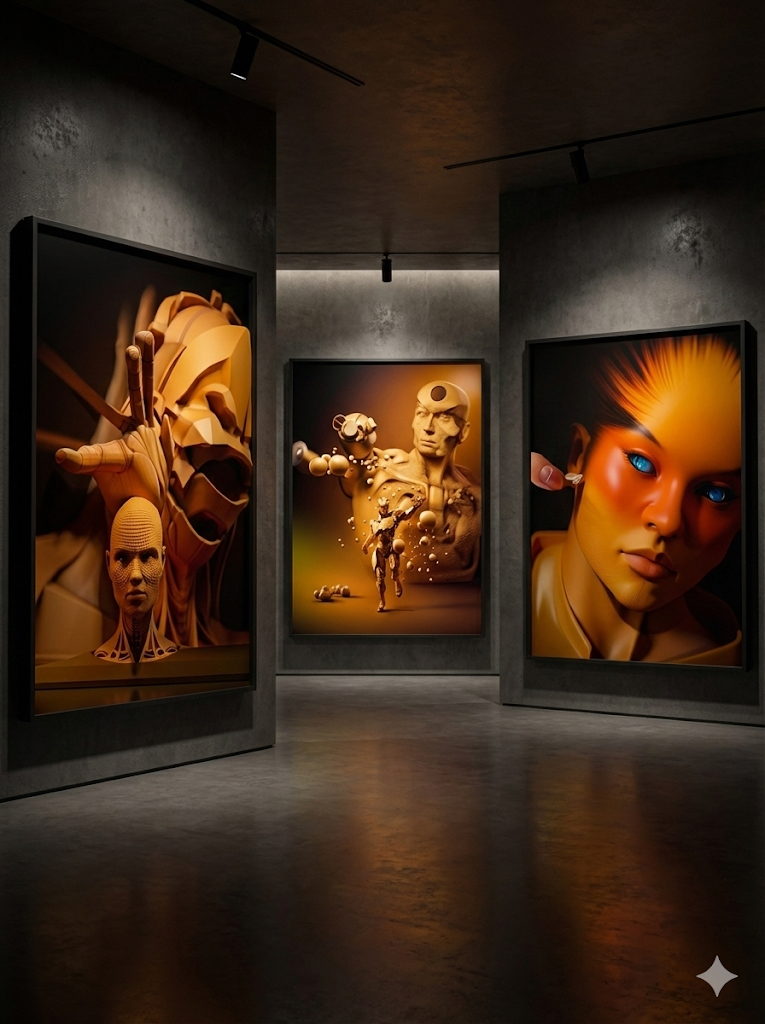
This installation presents a stark visual interrogation of the increasingly blurred lines between organic existence and technological advancement. Through a dialogue between sculptural form and digital imagery, the artist explores themes of transhumanism, assimilation, and the anxieties of a digitized future.

The Centerpiece: Chrysalis or Captive?

Dominating the gallery space is a monumental sculpture that masterfully contrasts materiality and form. A hyper-articulated, skeletal android—rendered in cold, industrial metallics with piercing optic sensors—is locked in a complex embrace with an abstract, fluid human form.

The contrast is visceral. The android is defined by rigid mechanical precision, gears, and hydraulics, representing the apex of synthetic evolution. The figure it holds is smooth, bronze-colored, and featureless, suggesting humanity stripped to its essence—or perhaps humanity in a state of molten transition. The nature of the embrace is intentionally ambiguous: is the machine protecting a fragile remnant of biological life, or is this the final moment of assimilation where the organic is consumed by the synthetic?

The Canvas: Migration into the Machine

On the adjacent dark wall, a large-scale digital print provides narrative context for the sculpture. We see stylized, glowing orange figures—echoing the color and smooth form of the bronze sculpture—walking in procession toward a blinding light source at the center of a massive, complex machine structure. The environment is a chaotic fusion of circuitry and gothic industrialism. This piece suggests a mass exodus, a pilgrimage from the natural world into a new, manufactured reality.

Conclusion

Together, these works create a tension-filled space that forces the viewer to confront the trajectory of our species. The exhibit asks a fundamental question: As we embrace technology, are we evolving into a higher state of being, or are we merely constructing the beautiful, terrifying sarcophagus for our own obsolescence?

A Place To Start

Hello!

If you got this far I guess you are interested in art in some way, shape or form.

As someone who has been making images for over 50 years, I may know a little about the artistic process. By process I mean the way art is made and emerges from each of us as individual artists.

And I have managed to keep my images new and fresh over time.

At the beginning I used oil paint, acrylic paint, charcoal, watercolors, and just about anything I could find that would leave a mark or imprint on a piece of flat or textured material, like canvas, canvas board, paper, primed hardwood or plywood, anything that had a surface.

After many many years my health started to suffer as a result of repeated contact with paint and its inherent materials.

But I still had this tremendous force inside me that had to be released. The power and force could only come forth through image making. Via color and texure.

Over the years I developed a style. I found an understanding as to how new images, or pictures are formed within my mind, and how to get them out into the real world. While this is a simple explanation of the artistic process, It is still the way making picture of image happens.

I needed a way to make this force real. Art became the way I understood the world and the universe, and my place within it.

Since I could not use oil or any type of physical paint because of health problems, I found a computer program, way back at the beginning of when they started making computers. The program was called Fractal Painter. It came on floppy disks sent to me inside a paint can. When I opened the can, I smelled the smell of oil paint. I knew something good was going to happen.

I still use Painter in its 2020 form, as it has evolved over these many years. What is more important is that over the years the artistic process and style I found at the very beginning of my career as a painter has been able to adapt to the software; i.e. I have adapted my vision and style to the computer software.